StepanUdalov
I design and build products end to end — from system architecture to the last pixel of the interface.
- Product
- Architecture
- UX
- years in development
- 0+
- years in backend & own products
- 0+
- days building Neurallux
- 0
Started with game development in Unity, then moved to backend and my own products.
The case
Neurallux
A constructor for Telegram automations.
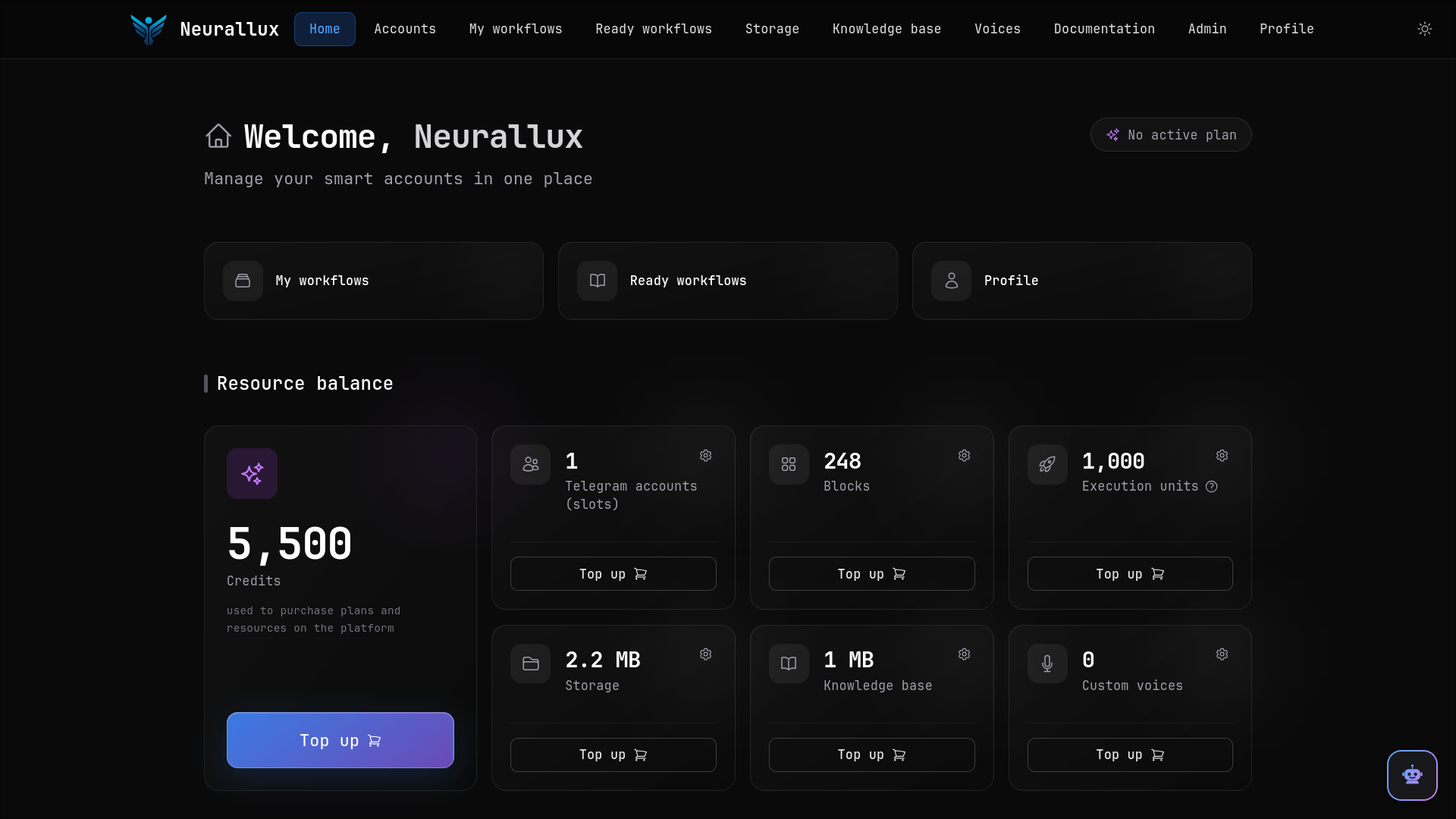
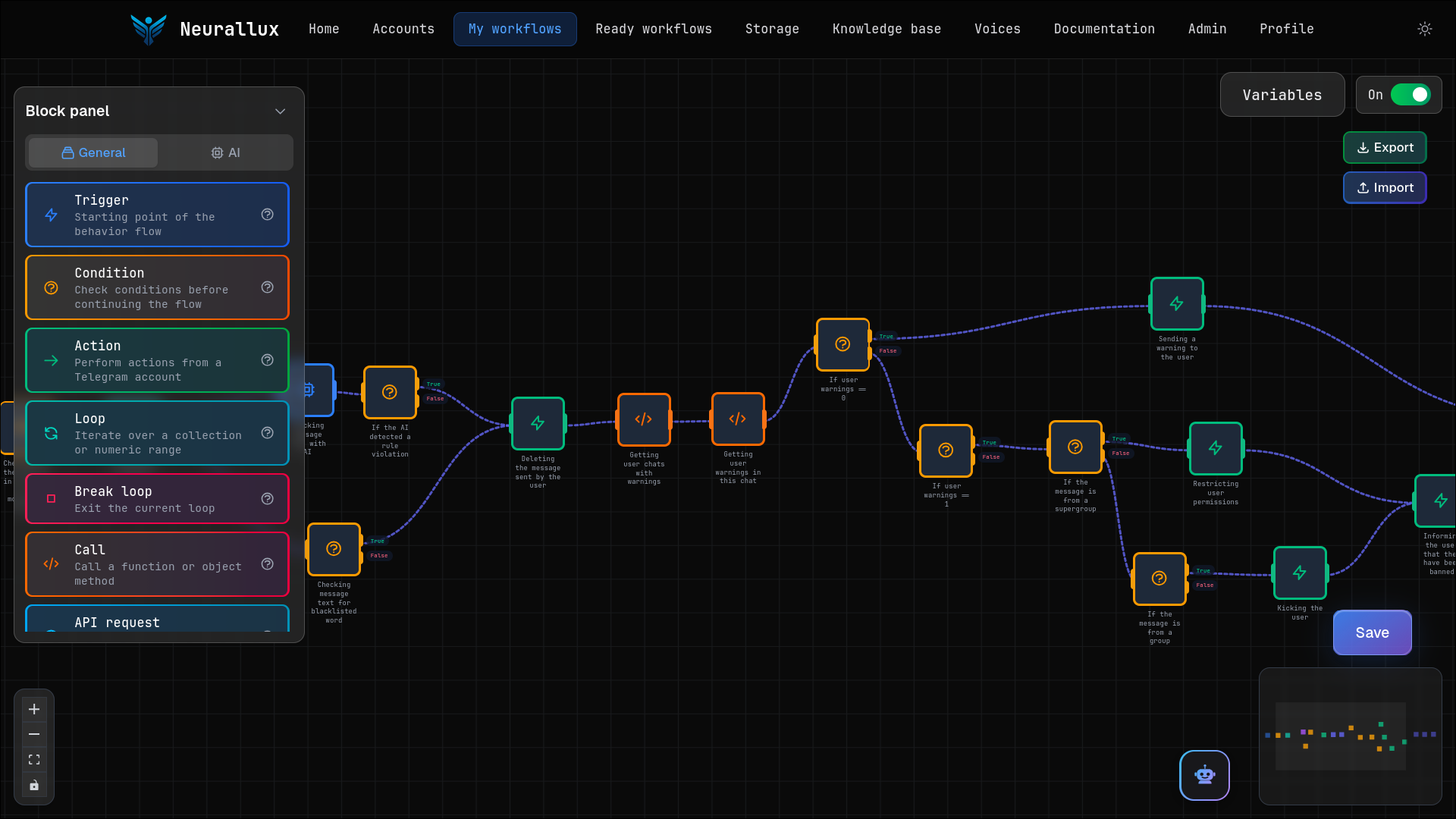
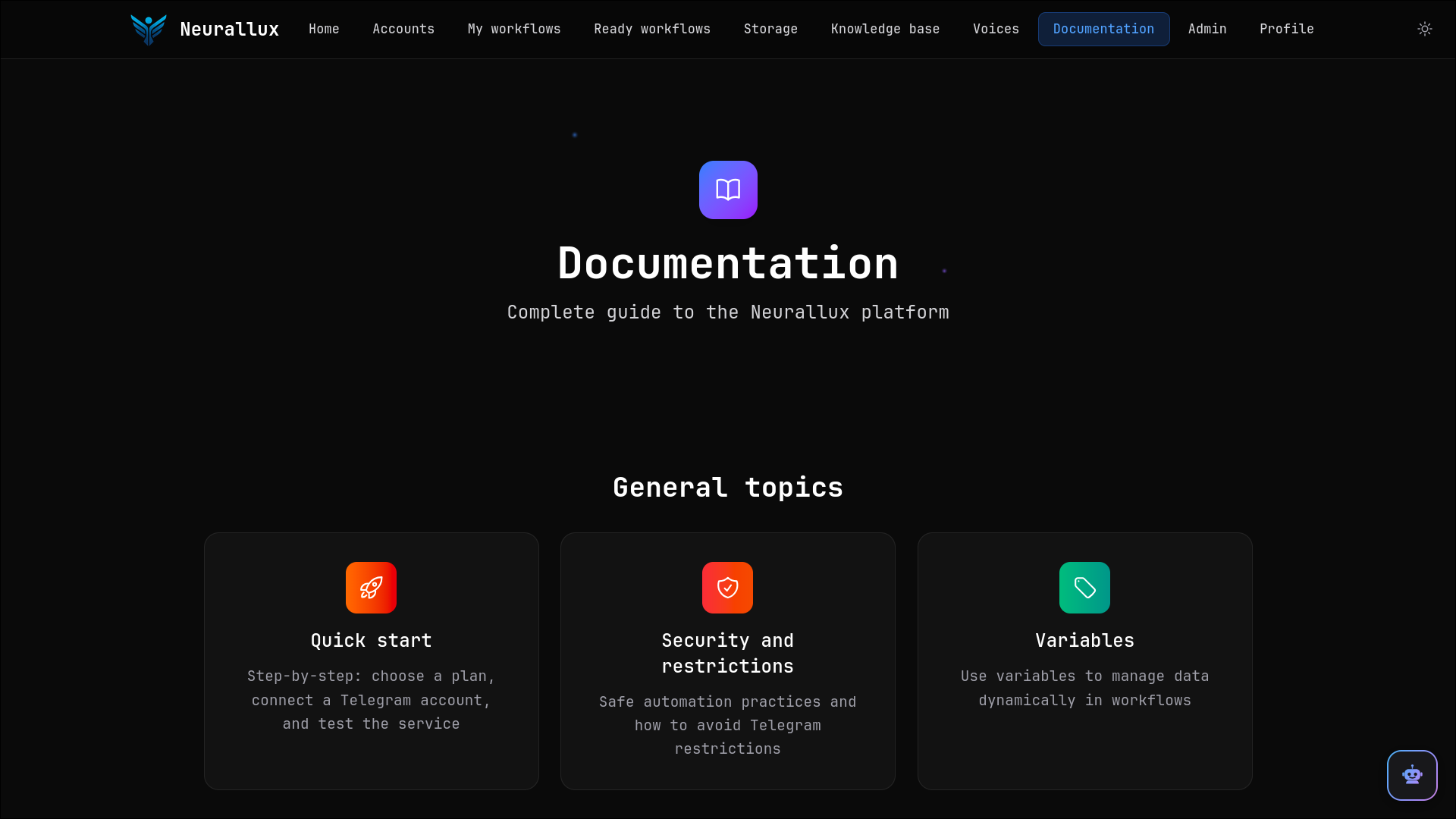
What follows is how I built it — idea, the technologies, the engine, then the work behind it.
neurallux.com ↗01 — Origin
It began as a monolith. It became a constructor.
22 May 2025. The first idea was simple: AI characters living inside real Telegram accounts. You set a name, an avatar, a personality — and the persona talked to people on its own.
Users kept asking for more: different reactions to different messages, delays, voice, knowledge, integrations. Every new wish was another hard-coded setting in a monolith.
So I reworked everything. The persona became just one possible scenario inside a visual workflow constructor — where anyone can build any automation from blocks.
“The hardest part wasn't writing new code. It was letting go of the old idea.
02 — Architecture
Drawn from the real repository.
Three services, one network. A web app for building, an API for thinking, and a Telegram service that manages accounts.
03 — Experience
Building Neurallux from the core to production.
My own product, where I own everything: backend architecture, security, the AI layer, infrastructure and the link to the frontend.
Fullstack Developer
Neurallux ↗/own product
What I shipped10
- feat(core)01
FastAPI backend with layered architecture
Designed the FastAPI backend with a layered architecture (endpoints / use cases / services / repositories) on PostgreSQL, Redis and SQLAlchemy, following OOP and SOLID, with secure authentication (JWT, RBAC, API Key, HMAC, AES-GCM).
- feat(auth)02
Registration & verification
Built user registration and verification (email + Telegram + OAuth2), protected against race conditions.
- feat(telegram)03
Multi-account Telegram service
Created a Telegram service on Telethon with multi-account support.
- feat(workflow)04
Workflow engine
Built a workflow engine for process automation, driven by the APScheduler scheduler.
- feat(accounts)05
Telegram account management
Implemented Telegram account management: limits, verification and webhook integrations.
- feat(ai)06
AI layer, RAG & billing
Built the AI layer: multiple models and providers (OpenAI, Anthropic, Google and more) behind a single abstraction layer, a RAG system with data stored in S3, and billing (YooKassa).
- feat(voice)07
Voice AI
Added voice AI (TTS, custom voices) that respects user limits.
- ops(infra)08
Infrastructure & deployment
Set up infrastructure and deployment: Docker, docker-compose, Nginx, SSL, VPS.
- lead(frontend)09
Frontend lead & API contracts
Led frontend development (Next.js / React / TypeScript) and owned the backend integration and API contracts.
- test(quality)10
Git & testing
Used Git for version control and pytest for testing.
04 — Skills
How the skills connect.
Every skill here ties back to real work in Neurallux.
Backend
Python and async services: APIs, Telegram bots and runtime, schedulers.
Skill areas9
05 — Timeline
Every day since 22 May 2025.
Neurallux is a living product. Development started on 22 May 2025 and has not stopped — the stable version is already in production.
May 22, 2025
Project start
AI personas in Telegram
June 7, 2025
Concept shift
Toward a workflow constructor
September 13, 2025
Beta test
Official public beta launch
December 25, 2025
Stable release
Workflows, multi-account, billing
Let's build something that works by itself.
Open to full-time roles and client projects. Remote or relocation. The fastest way is Telegram.